20 January 2014

A book that caught my eye: I'm Working on a Building by Pip Adam

Recently I had the opportunity to write a piece for the Book Council about a book that had caught my eye, design-wise. After a few days considering what I wanted to write about, I settled on a book I'd finished reading (twice - once forward, once backward). This isn't so much about the graphic design of the cover, but more about the physical/structural design of the cover, and how how it reflects the novel inside.

A book that caught my eye: Helen Rickerby

It isn’t until you hold the book in your hands and begin to read that you’ll really get just how disorienting the cover design of I’m Working on a Building by Pip Adam is.

We all know how book covers work: there’s a back and a front and a spine. The spine is on the left of the front cover, and the right of the back cover. We know how novels work: characters move through time chronologically (even if there are flashbacks); there’s a beginning, a middle and an end – in that order. But let go of what you think you know…

Read the rest on the Book Council site...

13 January 2014

Careless People and The Great Gatsby, or, What I read on my holiday

My main holiday book this year was Careless People: Murder, Mayhem and the Invention of The Great Gatsby, by Sarah Churchwell, which was - as I mentioned in an earlier post - awesome, and I'm going to devote this entire post to it.

This book, which describes itself on its back cover as 'the biography of a book' (the book being The Great Gatsby, which I should say at the outset that I love - I even loved the recent Baz Luhrmann film, somewhat to my surprise). It's kind of a carnival of a book. It's wide-ranging, academic while not being dull (or having footnotes - though it does have an extensive and scholarly notes section), and also is lots of fun and easy to read. It's an academic book for a general audience in a way - and I for one think more academic books should be like this. Brainy but fun.

It weaves discussion and interpretation of The Great Gatsby with especially relevant biographical info about the author, F. Scott Fitzgerald, his wife Zelda and their milieu, with contemporary trivia and current events that are likely to have had some influence on the story - especially the 1922 Hall-Mills case: a double murder of a rector and his lower-class choir-singer lover who aspired to greater things.

Scott and Zelda in the 1920s


A great deal of the book is concerned with 1922, the year the novel is set, and also the year F. Scott and Zelda returned to New York after a brief time back in the Midwest, and lived and partied on Long Island. It's also the year that the verb 'partied' had it's first recorded use: in a letter by poet e. e. cummings, in which he described a night spent with the New York literary crowd.

There is a whole fabulous section devoted to the language of the time. The book quotes Virginia Woolf, who, in 1925, said in an essay about American fiction: 'The Americans are doing what the Elizabethans did - they are coining new words. They are instinctively making the language adapt itself to their needs ... Nor does it need much foresight to predict that when words are being made, a literature will be made out of them.'

On the next page of Careless People lists words that were first used in the 1920s (including many I thought would have been much earlier, or much later - such as post-feminist), and then is a list of words that were first used in 1922: 'brand-name, Hollywood, moviegoing, rough cut, performative, robot, sparkly, schlep, dimwit, no-brow, oops, multilayered, rebrand, mass market, broadcasting and broadcaster, finalize, lamé, sexiness, transvestite, gigolo, to proposition, libidinal, post-Freudian, cold turkey, quantum mechanics, polyester, vacuum, notepad, duplex, Rolex, entrepreneurial and party-crashing '. I took the 1922 words along as a prompt to my New-Year's-Day writing session. Two of us wrote poems that included sparkly lamé at a party!

This is a bit of a digression, but I took another couple of quotes quoted in this book along to our next writing session as prompts. Firstly:
The artist, wrote Conrad, shines 'the light of magic suggestiveness' on 'the commonplace surface of words: of the old, old word, worn thin, defaced by ages of careless usage.'
This book is full of gems like that!

And, secondly, F.Scott Fitzgerald himself:
And lastly from that period I remember riding in a taxi one afternoon between very tall buildings under a mauve and rosy sky; I began to bawl because I had everything I wanted and knew I would never be so happy again.'
Tragic! But beautiful while being tragic. And also I clearly don't agree with his philosophy on happiness. But anyway...

The more I learn about F. Scott Fitzgerald the more amazed I am that he wrote The Great Gatsby, which to my mind is such a wise and insightful book. Fitzgerald himself does not appear to have been especially wise: he was a bit of a clown and was destroyed by alcoholism. It seems to me now that he wrote a book that is better and wise than he is/was. I feel the same about Tolstoy. I find it magical and wonderful that sometimes we can write above ourselves. (I once wrote a character who I'm quite sure was funnier than I am, though I don't know if I've been wiser, or even wise.)

Another big reflection of mine after reading Careless People is how I, and I think most present-day readers of The Great Gatsby, didn't realise quite how topical the novel was at the time it was published, how the events in it - the car crashes, the parties, the murders, the jazz age, etc - were so of the time. I mean, surely I knew but seemed to have forgotten that it is set during the prohibition - so no wonder so many people flocked to Gatsby's parties, where alcohol was free and also of high quality. Apparently hundreds of people (mostly poor people) died from drinking alcohol that had been made out of industrial alcohol, to which the government had added poison in an attempt to stop people drinking it. No wonder anti-prohibitionists in NZ used the US example as a reason to not ban alcohol!

When The Great Gatsby was first published, people by and large seem to have been unable to see past that up-to-the-minute surface. One early reviewer, Isabel Paterson, said that it was 'an imponderable and fascinating trifle,' that had not 'gone below that glittering surface, except by a kind of happy accident' and 'What has never been alive cannot very well go on living: so this book is of the season only...' She continues: 'He gets the exact tone, the note, the shade of the season and the place he is working on; he is more contemporary than any newspaper'.


As Sarah Churchwell says:
Fitzgerald's first readers could only see one half of the meaning of the book, its entaglement with the facts and contexts of the day, and were blind to its transcendent meanings. We tend now to focus on those universal meanings, letting our myths and misapprehensions about the 1920s take the place of facts about Fitzgerald's world. Each moment mistakes the part for the whole, seeing only one side of his book, the other side obscured by the darkness of the era's own blind spots, the lustre of the moon half hidden by the shadows of the earth.
The initial print run of The Great Gatsby was 20,000 copies and the reprint of 3,000 copies never sold out during F. Scott Fitzgerald's lifetime (his previous two books sold more than twice that). Fitzgerald, who had enjoyed early success and notoriety, had become largely forgotten, or at least dismissed, by the time he died in 1940. (He was only 44, but had been prematurely aged by alcohol.) His last royalty cheque, which covered a year, was for $13.13. His funeral had a few more attendees than Gatsby's, but not many. The minister who agreed to bury him 'charmingly' said: 'The only reason I agreed to give the service, was to get the body in the ground. He was a no-good, drunken bum, and the world was well rid of him.'

But it didn't take too many years for Fitzgerald's reputation to increase again, and especially appreciation for The Great Gatsby. And it might be true that we only see part of his work now, as Churchwell suggests, but we do generally now see through the surface of the novel to the universalness, the timelessness, the humanness of the novel. I kind of which Fitzgerald could know that - that his work is appreciated after all.


11 January 2014

My first writing session

Write a persona poem from the perspective of a dance, singing or instrument teacher about a student.

I am sitting at Maria's table with Maria, Helen and Helen. We're having a writing session. Above is my prompt.

I want to follow the rules, but I know that my immediate response would be a cliche, and I think that's often my problem with writing. And so I want to twist it somehow, weirden it a little. Make it not the nostalgic bittersweet thing that I first jumped to, that everyone could jump to, but something else. Something surprising and slippery. But there's the difficulty - how to turn it over, how to see it new? Perhaps the teacher is other than I expect, perhaps she is younger, not older, than the student. Perhaps she is not jealous of her student, or proud of them - him, her? Perhaps it's not about their relationship at all. Is it dance, is it music? What kind?
------------
And then the time ran out and I never did write that poem....

09 January 2014

A sort of a review of 2013 but mainly a list of the books I read (or at least the ones I can remember)

In my last post I said that 2013 had been a bit crap, which is true - there were some crappy things that happened. The main bad thing was discovering that we needed to do a LOT of work on our downstairs flat after our tenant of forever (well, seven years) left, and the money and time and especially the stress that ensued.

But many good things also happened, and I had lovely times with friends and family and so forth. It just got a bit much at the end of the year!

Principal among the good things of the year was having an enthusiastic publisher (Mary McCallum of Mākaro Press) want to publish Cinema (which, as I said in my last post, is coming out next year). I also really enjoyed doing some finishing work on Cinema, and getting some really good and helpful feedback from Mary and also from Anna Jackson.

Another highlight was publishing two fantastic new books - as Seraph Press: Paula Green's The Baker's Thumbprint and Maria McMillan's The Rope Walk.

Other highlights were the lovely poetry conference in Hawke's Bay and especially getting to read at it;  talking to writing students about publishing and publishing students about editing for the web (a bit of a step outside my comfort zone); a great trip to Auckland in May to launch The Baker's Thumbprint, attend (a little bit of) the Auckland Writers Festival and hang out with friends; restarting a writing group with a bunch of my friends (most of whom were part of the JAAM writing groups that the eponymous magazine came out of in 1995); launching the latest issue of JAAM, and oh a bunch of other stuff. Like going away for long weekends with Sean. That's always lovely.

And somehow I seem to have read quite a lot this year. Mainly novels and non-fiction - my poetry reading seems to have been a bit thin.

Among the poetry that I can remember off the top of my head, I read and enjoyed Kate Camp's Snow White's Coffin, Rachel O'Neill's debut collection One Human in Height, Janis Freegard's The Continuing Adventures of Alice Spider. Gosh, there's surely more! Oh, and the lovely Night Swimming by Kiri Piahana-Wong. A big highlight was actually reading an unpublished poetry sequence by Anna Jackson. It's called I, Clodia and is in the voice of an ancient Roman woman (and gf of Catullus). You too can enjoy it probably sometime this year - it will be in Anna's next book.

This is some other stuff I read that I can remember:
  • Biographies of Virginia Woolf. I read two of these, one after the other. The first was a shorter, introductory sort of biography. I think it was a necessary introduction to the other, much longer and more in-depth biography by Hermione Lee.
  • I had quite a run of New Zealand fiction, beginning with The Last Days of the National Costume by Anne Kennedy. I've mainly only read Anne's poetry (I especially recommend The Darling North), but she's a fantastic novelist too. The strongest part of the book for me is the middle, where one character talks about his childhood in Northern Ireland. It was amazing. Riveting and straight to the heart.
  • Dead People's Music and The Fall of Light by Sarah Laing. Both were great, and I loved the images in The Fall of Light. I also read four collections of her comics, which I bought off her after a talk at the National Library. I've been really enjoying her comics online, especially the ones that feature Katherine Mansfield (often interwoven with Sarah's own life). I'm really looking forward to reading her completed graphic novel about Katherine Mansfield (being the big fan of KM that I am).
  • The Unspeakable Secrets of the Aro Valley by Danyl McLauchlan. It was strange and exciting to read about my own neighbourhood, albeit reflected in a rather distorting and somewhat grotesque mirror! Also cool to read about characters based on people I actually know (also distorted). I was a bit disappointed that The Campbell Walker, while a great villain, didn't seem much like the real Campbell Walker, who I think would also make an excellent cult leader. The launch of this book was also a highlight, not just for Danyl's hilarious launch speech (Sean said it was the best launch speech he'd ever heard, which of course offended me greatly as he's been at all my launches), but because we got to nose around inside the School of Philosophy on Aro Street, which we've all been dying to see inside for years.
  • The Luminaries by Eleanor Catton. I started reading this when I wasn't very well, hence I could devote the necessary vast swathes of time to it. Consequently it only took me a week to read (and really only in the weekends). And, for all its size, it is quite a fast read. It took me a little while to get over the fact that a book I knew was written by a young woman who lives in Auckland sounded like it was written by a bunch of crusty old Victorian gentlemen, especially at the beginning. But once I got past that dissonance I was impressed with the writing. And the end gets rather spare and lovely. It certainly is ambitious and, while it didn't entirely connect with me, I'm delighted she won the Man Booker Prize, and I loved her speech and her philosophy of writing. I was also pleased I'd read it before she won the Booker, so I could become the resident expert on The Luminaries at work, as the only person on my floor to have read it.  
  • I'm Working on a Building by Pip Adam. Conversely, this is quite a small novel, but it took me ages to read in little bites. I wanted to savour it and give it space. It's a book that builds up piece by piece, and the characters, especially the protagonist, don't reveal themselves to us in a hurry, but it's worth the wait. It's like there are concrete blocks under the words, giving it weight and density that I didn't expect from the size. Its chronology runs backwards, chapter by chapter, and it's like nothing I've ever read. I think this is an amazing and important book. I've written about it for the Book Council's online newsletter thing, so I'll link to that when it's up.
  • Forty-One False Starts: Essays on Artists and Writers by Janet Malcolm. I love Janet Malcolm's writing, and these articles and essays are almost all amazing. Especially the longer ones - towards the end were some shorter pieces that I'm not sure deserved collecting, but still, great book.
  • Memoir of Silence by Lloyd Jones. I love me a good wide-ranging, thinky memoir, and this didn't disappoint. While my family isn't quite like his, I related to the things he was remembering and exploring, and the story he uncovered about his mother is fascinating and rather sad. 
  • Artful by Ali Smith. I'm still not sure what this book is. I mean, its several lectures that Ali Smith gave about art and stuff, which mix fact and fiction, but I'm still not sure where the fact ends and fiction starts. They purport to be based on notes that the author's partner (who is haunting her) left when she died, but I think (from reading the internet) that Smith's partner is alive and well, and that Smith herself is not in fact a tree surgeon. Anyway, lots of lovely things along the way, though I wasn't quite sure what it all added up to when I was finished. Also, for some reason these lectures didn't seem to go through a usual editing process when they were published, and so things like book titles weren't in italics when they should be, and for some reason that niggled at me quite a bit. Gosh, that all sounds much more negative than I feel about it - it was a joy to read, with lots of little treasures.
  • The Year of the Flood by Margaret Atwood. I finally got around to reading this. I'm a big fan of Margaret Atwood - I wrote my masters thesis on fairy tale intertextuality in her fiction, but I actually haven't really liked anything she's written since Alias Grace (which came out while I was writing my thesis and I managed to sneak it in). Has she changed, or have I? I feel that she has become more propagandistic and less artful, and also just less good. Possibly I disliked The Year of the Flood slightly less than Oryx and Crake, of which it is the sequel, but then I also had lower expectations. I started to read MaddAddam, but stopped after a few pages because I just didn't want to continue. Maybe I'll finish it this year - they're a trilogy and I do hate a loose end. No, that's a lie, I love loose ends in all sorts of things, but I do usually finish what I've started.
  •  The last book I read in 2013 was A British Picture: an Autobiography by Ken Russell, which I devoured in a couple of days after Sean gave it to me for Christmas. It's great! Whatever you might think of Ken Russell's movies, he sure can write. This was thematic rather than chronological, which I really liked. I love his movies, even when they're awful, and it has sent me back to watching some more of them, and re-watching some. We re-watched The Lair of the White Worm the other night, which is great fun. When I first watched it I was sure it was supposed to be funny, though this time I wasn't entirely certain of that. Very surprised to see Malcolm Tucker (Peter Capaldi) as the archaeologist. So young!
I also started, but didn't finish, Careless People, which is all about The Great Gatsby and is so awesome that I'm going to devote an entire post to it.

What did you read? Have you read any of those? Thoughts?

05 January 2014

Welcome to 2014! And a sort of announcement of something you probably know already

I have high hopes for 2014. Last year was a bit crap, for various reasons, but this year is going to be awesome. I am determined. And there are some very cool things coming up, which I'm sure will make for a good year.

It has started off very well so far. We spent New Year's Eve in Paekakariki with a dear friend who lives overseas these days. We had been planning to go to a party, which would have been lots of fun, but instead we decided to stay in and spent the evening reflecting on our plans, goals and hopes for the year, which felt right. The next day I got to hang out with some poet friends who were about - mainly because they live there - and we even had a writing session, which felt like a very auspicious start to the year. I'd never written with other people quite like this before: the four of us sitting around a kitchen table and, with the help of prompts, writing solidly in our notebooks for blocks of time from five minutes to half an hour. It didn't matter what we wrote, but our pens just had to keep moving. I think one of the main advantages is that you can't just go and check that one thing on the internet, and then inevitably fall down a rabbit hole; but I also loved being in the same space creating with those dear poetic minds. We did the same thing a couple of days later, and I hope for more of the same.

Writing is going to be my focus for at least the first half of this year. My own writing. I've decided to not begin a new publishing project until at least the middle of the year. The particular reason for this is the most exciting news, which I think I've probably told most of you already, but which I haven't formally announced or anything, so this is my formal announcement:

My new poetry book, Cinema, is going to be published by Mākaro Press! (It's scheduled for March at this stage.) Mākaro Press is a new published company started by the multi-talented Mary McCallum, which has just published the fabulously successful Eastbourne: an anthology. Cinema is going to be published as part of a batch of poetry books, a triptych perhaps. It's in fine company: the other two are a debut book, Bird Murder (a murder mystery in poetry), by Stefanie Lash, and a collection of love poems by Michael Harlow. So, a new poet, an eminent poet, and me.

The poems in Cinema all take film, films or/and film-making as a jumping off point, but they fly in all kinds of directions and explore other themes and ideas. I've been working on Cinema for a long time now, writing the poems, and then working on the poems, and shaping the book and reshaping the book, and then reshaping the book again. At several points in the process I've had some trusted people read the poems, and then the manuscript, and give me lots of helpful and encouraging feedback. It's a better, and shorter, book for all that.

Another thing I want to do this year is blog a bit more again. I haven't much in the last few years, and it hasn't been where my head or time was at, which is fine. But I think that sort of reflection and kinda public-ish writing is something I want to do again, for a while anyway.

What are your plans for your year?


10 December 2013

Tuesday Poem: 'Alice Spider Visits her Nanna' by Janis Freegard


Alice Spider goes to South Shields to visit her Nanna. Nanna doesn't like the Blairs. Every time Cherie comes on the television, Nanna says, that skinny little bitch. Tony fairs no better. He's a crook. Look at him, grinning like a Cheshire cat. He's bloody evil. Nanna doesn't support a united European currency.

People starving in Africa? They should sterilise them. Asylum seekers? Taking jobs from our men. Striking miners? I didn't give them a penny. They never gave the pensioners any coal. Northern Ireland. Your Granddad always used to say, there'll never be peace in Ireland. They should pull the soldiers out and then drop an atom bomb on them.

As long as it only killed the right ones.

Nanna's a Sun reader. She can tell you about every affair that every politician, footballer and television personality has ever had, not to mention their operations. She wasn't sorry when Diana died. EE, she was a slut. Them poor bairns.

(Alice knows that even if she were an Irish miner slut in Africa, Nanna would still get up early to cook bacon and eggs for her breakfast, despite Alice's protests. It's a different kind of love you have for your grandchildren, says Nanna.)


I must have first met Alice Spider in AUP New Poets 3. She's quite charming character, fun to hang out with, but perhaps a little unpredictable. I came across her again in JAAM 28, and then this year she got her own book: The Continuing Adventures of Alice Spider (I kind of always knew she would). The book was published by Anomalous Press in the US, and was part of a fun Kickstarter campaign (which is how I got my copy), but you can also get it from Matchbox Studios in Wellington or Unity Books in Wellington.

I chose this poem simply because it appeals to me, but I'm having a bit of trouble articulating why. I find it quite funny, in a wry way, though bigotry shouldn't be funny. I guess it's the split, the tension, between the good person you know and love, and the terrible things they say and think. 


Janis Freegard's debut poetry collection, Kingdom Animalia: the Escapades of Linnaeus, was published in 2011 by Auckland University Press. She also writes fiction and is a past winner of the BNZ Katherine Mansfield Award.  She lives in Wellington with an historian and a cat. She has been writing poems about Alice Spider since she was 18. I expect to see Alice around some more, having new adventures, some time in the future.

For more poems, visit The Tuesday Poem blog: 

02 December 2013

What do editors want?

A few weeks ago, at the Hawke’s Bay poetry conference (which I blogged about a little a few weeks ago), I was on a panel called ‘What do editors want?’ (or something like that). This is editors of a commissioning editor sort, rather than a copyeditor sort (which I also am). On the panel with me were Siobhan Harvey, who has edited issues of Poetry NZ and has been the poetry editor of Takahē, Nicholas Reid, who has edited several issues of Poetry NZ, and Doc Drumheller, editor of Catalyst. It was a good session, chaired by Laurice Gilbert, president of the Poetry Society.

But, we each had five minutes to speak at first, to answer the question from our own perspectives. And, while I didn’t think my bullet points would take very long to cover, and I worried that I wouldn’t have enough to say, turned out I had HEAPS to say! I really didn’t cover all of the points I wanted to make. So I decided I would turn my notes into a blog post, in the hopes that they will be useful. So, here goes….


-----------
I’m going to talk to today with two hats on – two imaginary hats – one is as the co-managing editor of JAAM literary magazine, and the other as the managing editor and general dogsbody of Seraph Press. [I think in the actual talk I burbled for quite a while about both of them and held up some books to show off how pretty they are, etc…] The things I’m looking for in each role are similar, but there are some differences too.

As the only one of us who is also a book publisher, I might concentrate a bit more on that [I totally didn’t, because I was running out of time…]

So, what do editors want, apart from fame, fortune and world peace? Well, I’m going to talk about what I want as an editor, and assume that other editors want something similar.

  • I want good writing. Or, to be more specific I want writing that I think is good writing to me. Let’s be honest, subjectivity does come into it – editors do have their own taste and can only back things they can see the merit it. Through reading a journal, or through submitting to it, you can get a sense of the sort of things an editor will like, and find editors who appreciate the sort of work you’re doing.
  • I want writing that speaks to me, surprises me, expands me. Things like fresh new images, ideas or ways of saying things. If you’re saying the same thing as everyone else in the same way, then it’s not going to excite me. But if you say new things, or say them in a new way, then I’ll notice. Read over your work and look out for clichés. And then take them out, or make them new somehow. Originality – your own voice. Beautiful language, which doesn’t have to be flowery – it could be really spare.
  • I want writing that gives me a little shot of jealousy.I want you to read the submission guidelines.
  • And I want you to follow them. Don’t send too many poems (or stories) and don’t send too few. About three to six poems is generally a good number. I'm not as strict as some editors - some won't even read your submission if you don't follow the guidelines to the letter. But I will probably be less well-disposed to your submission than I would be otherwise.
  • I want you to not be discouraged by rejection, but be gracious and try again. When you start out, especially, it’s wise to expect to have your work rejected (and then be delighted when it isn’t).
  • I want you to read other people’s writing, past and present. And buy other people’s books (especially New Zealand poetry) and literary journals (especially JAAM!) New Zealand's literary culture won't thrive unless we support it.
  • I want you to always try to become a better writer. I want you to be constantly aiming to grow and develop your craft. To push yourself.
For a Seraph Press book
  • I want all of the above, but to an even higher standard.

  • I want work I’m in love with – its my money and, more importantly, my time, and I need it to be a project I love so much that won’t resent it.

  • I want poems that work together to create a whole book – that’s more than the sum of its parts. That doesn’t necessarily mean it has to be thematic though.

  • I want a manuscript of even quality – cut out the weaker ones, or make them better. I want you have worked hard on it, and perhaps had other trusted people read over the manuscript and give you feedback before you even send it to me.
  • That said, I want to be able to work with you on polishing the collection. I want you to be willing to work and collaborate with me to make the work shine. To make a collection we're both happy with and stand behind. So I want to you to be open to input, and I want to you to know your own mind.

  • I would expect to have heard of you before – if not, why not? Not because I only publish ‘name’ poets, but because I want you to be engaged with the poetry community in some way, to have published some poems in literary journals, to go to readings, to be involved in poetry on the internet, or be involved in the community in some other way. (This isn’t the case at all with JAAM though – we don’t care at all if we’ve never heard of you before, so long as we love your work.)
  • I want to know why you want ME to publish your book. I’d want you to be familiar with what I’ve published before. I don't want it to just be because I'm a publisher, and any publisher will do.
After each panelist had spoken individually, the we also answered some questions – though we didn’t all answer all of them. But I had prepared answers for all of them, so I’ll include them all here.

As editors, who do you consider your readers are? 
The readers of literary magazines are generally other writers. Also the friends and relatives of the contributors (especially if it’s their first publication – friends and relatives are less excited when you start racking up a lot of publications). There are also a few wonderful, precious people who aren’t writers but are just interested in literature.

Is it harder to get accepted the first time you submit something?
In terms of your first submission anywhere, yes, I think it is, simply because you’re likely to be a newer writer and not as good yet as you’re going to become. In terms of your first time submitting to JAAM – I don’t think so. The work stands on its own merit, and if the editor loves it then it goes in. Quite a lot of writers who have carried on to fabulous things have had their first publication in JAAM, and I’m really proud of that.

Are there some topics editors prefer to avoid? – and if so which?
I think that depends on both the editor and how the topic is approached. I don’t think any subject is necessarily off limits. Personally, I wouldn’t publish something that I consider abhorrent, like a racist poem, but a poem about racism could be great.

What percentage of the poems submitted for publication in your journal is accepted.
We haven’t scientifically analysed the stats lately, but we estimate that around 20% of submitters to JAAM will have work accepted. We’re becoming quite a big journal, but we get a lot of submissions, including quite a lot from overseas (of which we publish hardly any, because we're primarily a journal for New Zealand writing).
-------------

I'm sure there are heaps of other things I should say, like always include a covering letter, and return postage if you're still posting (for JAAM, we'd rather you emailed), but it's a bit of a brain dump. Thoughts?

19 November 2013

Tuesday poem: 'Sigourney Weaver and I Go to Bed' by Emma Barnes

Sigourney Weaver and I Go to Bed

Sigourney Weaver flew me some place on what seemed a too small
aeroplane. We didn’t talk about her appearance in Avatar. The
papyrus got between us: A font of discontent. She held my hand
inside her shirt and said that she just wanted me to hold her up.
I had a potato gun in my back pocket. She passed the tuber.

After landing we arrived at a white bed. It seemed as tall as she was
to me: a more dumpling sized human. There were steps around the
edges and the middle was a long marshmallow cloudland in the style
of my home country. I could see her foggy outline reflected in the
roof. Her flannelette pyjamas were covered in the faces of dogs.

‘This is where we go to bed’ she said. I looked up into her size-9
eyes. ‘But, I’m more of a cat person?’ This was just like going out with
the 42-year-old butch I dated when I was 21. A lot of determined
looks and short phrasing. But she was already up on the mountainy
pillowtop and a long, slender arm loomed at me. The life rope of

a completely different social class. This place was no Dream Father
mansion, but it sure had something going for it. I was lying in bed 
with you. It was a Thursday. Outside the white noise said it was 
summer and the cicadas were okay with that. It had been clear weather
for almost ten days. Standing in the sun a person could be 

described as hot. But I’m not allowed to write letters in bed, says
Sigourney. The ink will make a mess of the linen. So I lie there
composing in my head. In bed with Sigourney Weaver. In bed with
you. She can palm a basketball. You’re more of a music man than
sports fan. Sigourney Weaver and I go to bed. All I can think of is you.

Emma Barnes

(Please forgive some of the line breaks, my design just isn't wide enough to fit the longest lines)

I wanted to share this poem because Emma read it at the launch we had for JAAM 31 on Friday, at 19 Tory, a space run by the Concerned Citizens Collective (thanks guys!). We hadn't had a bit public launch for JAAM for a long time - or actually maybe never. (Though we have had smaller launches from time to time, but not that often.) It was really lovely to gather together the Wellington-based contributors (though more of them are scattered around the country) and have a celebration. It was nice to put some faces to names, and also people could put our faces to our names. JAAM has been quite an anonymous work sometimes and it was good to connect with some of our community.

Cover image by Andy Palmer, cover design by me


But the big treat was having some readings from a few of the wonderful writers whose work is in JAAM - Helen Heath, Tim Jones, Pip Adam, Sandi Sartorelli, Lucy Kirton, Chris Tse and Emma - and there were more writers we would have loved to have had read too.

This poem by Emma is just one of three 'Sigourney Weaver' poems in this issue of JAAM, which are just three of many of a wonderful series. They're all quite different, but they all have the same form, and a similar tone I think. I've been loving seeing more and more of them appear

As well as in JAAM, you can read more of them in the recently published 4th Floor journal, and in Cordite, and you can listen to some on Soundcloud here and here (this is the poem above).

And once you're done with Sigourney Weaver, you might want to check out some other Tuesday poems at the hub: http://tuesdaypoem.blogspot.co.nz/.


12 November 2013

Tuesday Poems and 4th Floor and Ray Harryhausen

A poem of mine, 'I hear you singing in the next room' is the Tuesday Poem over at the hub blog this week! Thanks so much to Janis Freegard for selecting it. It was published in My Iron Spine.

There's also a poem of mine, 'Vana’s life, as directed by Krzysztof Kieślowski and Ray Harryhausen', in the just-launched issue of 4th Floor Literary Journal, which is published by Whitireia Polytechnic and edited by the very lovely and talented Hinemoana Baker. This poem came to me, or started to come to me, when I thought I'd already finished the manuscript for Cinema, and so was a late arrival. And actually it arrived in two parts - I  had the beginning, but didn't know where it would go, or even if it needed to go anywhere - it could have stayed an almost haiku. But a few months later I sat with it again and the rest turned up. It seemed a good ending poem - a goodbye-to-the-project swansong. And I've put it near the end of the book - though not the very end.

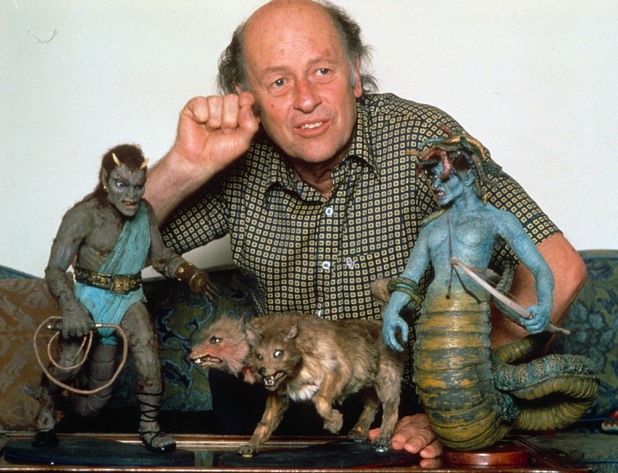
Ray Harryhausen and some of his creations
Subsequently I've seen quite a few more Ray Harryhausen films - he died not long after I wrote the poem. If you're interested in his films, they've been showing a retrospective at The Roxy in Miramar, and this Sunday it's Jason and the Argonauts, which I think might be my favourite of his films. Or maybe that's Clash of the Titans... anyway...

There's heaps of other great poems and stories in this special issue of 4th Floor, which marks the 20th anniversary of the writing course at Whitireia, but also of the publishing course, which I did many mumble years ago and in which I learned heaps of useful things that has kept me in gainful employment and has also helped me with various publishing ventures. I haven't had a chance to read this issue thoroughly, but can see from the contents page that there are heaps of my favourite writers in there, and probably lots of yours too.

05 November 2013

Tuesday poem over on the Tuesday Poem, and Hawke's Bay poetry conference

I'm the editor of the Tuesday Poem blog this week. I always enjoy having the opportunity to share a poem I love, and this time I've chosen a poem, 'No time like the ‘80s/ No future' by Airini Beautrais, from the latest issue of JAAM, which has just come back from the printers and is filling up a large area of my dining room. It's a great issue, guest edited by Harvey Molloy (poetry) and Clare Needham (prose), and I hope you will get yourself a copy. You could even subscribe and we will send it to your letterbox!

In other news, I'm just back from a poetry conference in the Hawke's Bay. It was organised to celebrate the 20th (or maybe 21st) anniversary of their Live Poets Society group. It was such a lovely conference with a really good, open, sharing feeling. There was such a variety of poets - different ages and levels of experience, and totally different styles of poetry. And very democratic. The only poet who got longer than anyone else to read was Vincent O'Sullivan as the poet laureate. All the rest of us invited readers only got 10 minutes - strictly enforced!

I got to read my poetry on Saturday night, and I was also involved in a panel discussion about what editors want (what don't we want!) yesterday morning. Due to poor time management and having too much to say, I think I only said about half of what I wanted to say. So I have an idea I might write it up as a blog post.


14 October 2013

Happy 125th birthday Katherine Mansfield

Today it is 125 years since Katherine Mansfield was born. Apparently the weather was really crap then too. Her story 'A birthday' was apparently sort of about the day she was born, and there was a 'southerly buster'. I'm not sure which direction the wind and rain is coming from today, but it's sure blowing a gale. I guess those are the dangers of spring in Wellington.

Anyway, in honour of her birthday I wrote a blog post about her on my work blog, over here: http://blog.teara.govt.nz/2013/10/14/who-the-hell-was-katherine-mansfield/. I hope you might go read it, as I'm rather pleased with it and I hope it explains a bit about why I'm such a fan of KM. (It was very hard to write - I had too much to say!) I'd also be delighted if you contributed to the debate in the comments, especially about the statue of/for her in Wellington. The reasons people give about whether they like it or not tend to be the same reasons. Everyone finds creepy and robotic, some of us just quite like that.

In my blog post I mention that KM was the first woman in all of London to wear stockings. When I wrote a poem (well, actually one of two) about her for My Iron Spine I included that fact (at least, I think it's true). You can read the poem here: http://wingedink.blogspot.co.nz/2013/02/tuesday-poem-partying-with-katherine.html.

06 September 2013

My Iron Spine gets some love, and what I'm doing today

Matchbox Studios, a really lovely art gallery/shop/studio on Cuba Street, has started stocking my Seraph Press books (ie published by me). I also took down some copies of my own books (ie written by me), and they're selling them too. And they've made My Iron Spine their 'zine' of the month! Simon Gennard's review is really lovely, and I'm buzzing that it's getting some nice attention when it's five years old.

What I'm doing today is working on the (hopefully) final revisions of its newest sibling. (I'll tell you more about that exciting news soon.)

I've taken the day off work to have a poetry day; so I've been moving some poems around the manuscript and reworking a couple of more troublesome ones that I know (and my readers have pointed out) aren't quite there yet, but which I still want in the book and so have to lift them. This one, 'Revolutions', has been in many forms over the years since I first wrote it. You can read it in an earlier form here: http://snorkel.org.au/015/rickerby.html.

But I've been turning it over, and around, in my mind, and this is what I've come up with. I'm much happier with it now. I hope you think it's better too:
(If you listen closely, you'll hear hammering and so forth, which comes from the builders working away downstairs, who also inspired a poem I wrote earlier this morning.)

And now back to the poetry!

26 August 2013

Tuesday Poem: 'Deep water talk' by Kiri Piahana-Wong


Deep water talk

In honour of Hone Tuwhare

& no-one knows
if your eyes are
blurred red from
the wind, too
much sun, or the
tears streaking your
face that could be
tears or just lines of
dried salt, who
can tell

& you never can tell
if you are seasick,
drunk, or just
hungover—the
symptoms are the
same


& sea and sky merge
until the horizon is
nothing but an
endless blue line in
every direction, so that
you are sailing, not on
the sea, as you thought,
but in a perfectly blue,
circular bowl, never
leaving the centre

& you wonder who
is moving, you or
the clouds racing
by the mast-head

& you wonder if
those dark shapes
in the water are
sharks, shadows, or
nothing but old fears
chasing along behind
you

& the great mass of
land recedes, you
forget you were
a land-dweller,
feeling the pull
of ancient genes,
—in every tide, your
blood sings against
the moon

& food never tasted
so good, or water
so sweet—you've
never conserved water
by drinking wine
before—and rum;
and coke; and rum
and coke; and can
after can of cold
beer

& your sleep is
accompanied, not
by the road of traffic
on the highway,
but by the creaks
and twangs of your
ship as she pitches
and moans through
the dark ocean,
all alone

& you wonder—
where did that bird,
the great gull perching
on the bowspit,
come from?


Kiri Piahana-Wong is a New Zealander of Māori (Ngāti Ranginui), Chinese and Pākehā (English) ancestry. She has degrees in law and English literature from the University of Auckland, and has had a varied working life, including roles as a legal editor, sailing instructor, freelance writer, event manager and publisher. Her work has appeared in many journals and anthologies, most recently in Dear Heart: 150 New Zealand Love Poems (Godwit), Mauri Ola: Contemporary Polynesian Poems in English (AUP), Trout, and Ora Nui. She is also a performance poet, poetry slam champion, and a former MC at Poetry Live, New Zealand's longest-running live poetry venue. Kiri lives at Laingholm on Auckland's west coast.

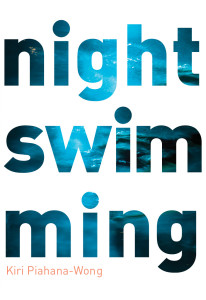
This poem is the first poem in Night Swimming, the debut collection by Kiri Piahana-Wong. It's the perfect poem to begin the collection, a good, strong poem, heavy with silence and the weight of the Pacific Ocean. I think my favourite bit of the poem is: 'you are sailing, not on / the sea, as you thought, / but in a perfectly blue, / circular bowl'. Gorgeous!

Water runs through the poems of this book in many forms - rain, tears, swimming pools, ice, rivers, clouds, fog, but especially the sea. The poems themselves have a lot of variety though, in tone and in subject matter. The gravity poems like 'Deep water talk' are balanced with more conversational, busier poems. Other favourites in this collection are 'On Commerce St' both 1 and 2, which chronicle life in an inner-city apartment, and 'Continental drift'.

Night Swimming was published by Anahera Press, a small press which focuses on poetry by Māori and Pasifika writers, which Kiri founded in 2011. If you want to buy Night Swimming, you can buy it from the Anahera Press website, from a variety a bookshops including the Women's Bookshop, or by rocking up to your local favourite bookshop and ordering it, as I did.

For more poems, check out the Tuesday Poem blog: http://tuesdaypoem.blogspot.co.nz/.


29 July 2013

Tuesday poem: 'Swimming lessons with Virginia Woolf '

Swimming lessons with Virginia Woolf

Virginia and I
float downstream
Our overcoats billow
surround us
I worry my feet
will get caught
in the Medusa weeds
that wait in the shadows

‘We all have boulders in our pockets’
she says
‘Most we place there
ourselves, some we are given
Medea gifts, poison’

I watch the banks
as we pass
I roll onto my back
she laughs at my Ophelia
Now my hair is wet
‘Look,’ she says
and there are golden fish
swimming beneath us

Virginia with her friend Lytton Strachey


I've been away for the weekend. It was wonderful. Mere hours after leaving behind ordinary life and all those little obligations, I was scribbling away in my notebook. I felt like my writing brain had switched on. (I've been pretty busy lately, doing stuff like this: http://www.seraphpress.co.nz/1/post/2013/07/the-rope-walk-has-set-sail.html).

As well as writing (and sometimes inspiring the writing) I was also finishing off a gigantic biography of Virginia Woolf by Hermione Lee, which I had been reading for months. It's a fabulous biography, but it was helpful to have read a shorter and more strictly chronological biography just before. Because Lee's biography, rather than being strictly chronological, is arranged thematically. I feel that method of arrangement would likely have had Woolf's approval, being an experimental sort of writer, with an interest in pushing boundaries.

Part of the problem of reading the end of the biography more quickly, over a leisurely weekend, is that it had the effect of speeding up the later part of her life, which was a bit startling. And I felt like the book ended abruptly, with her death. While in does seem kind of sensible for a biography to end with the subject's death, I had felt certain hers would be different. She has not only lived on through her work, but actually grown in literary stature. I was expecting a detailed look at how Leonard Woolf (her husband) dealt with her literary legacy, how scholars, critics and of course readers have changed in their responses to her work. How she has influenced others who have come after. There was a bit of that, but in a rush. Perhaps I've just read too many biographies of Katherine Mansfield, where people are always arguing about that sort of thing - about whether her widower (John Middleton Murry) exploited her memory and her work. But I was surprised that there doesn't seem to have been any (that I've read at least) criticism of Leonard Woolf for publishing so much of her work posthumously, when she explicitly said on the back of the note she'd left for Leonard to find after she'd drowned herself in the River Ous, 'Will you destroy my papers'.

But I digress, as I often do. Reading about her, and about her death, sent me back to this poem. This is the final, finished version (which was published in My Iron Spine), but I wrote an earlier version, which I read again a wee while ago. It was much darker. Much more depressing. But it wasn't what I wanted. It wasn't right for Virginia (as I most impolitely think of her). Because although she had difficult times in her life, including at the end, when – in the middle of the Second World War, when she and her friends justifiably believed invasion might be imminent, and they were on the 'Black List' – she was so scared that she was going mad again that death seemed the better option. But most of her life wasn't like that. Most of her life she was ALIVE, and witty and busy and bitchy and a good friend and a challenger of the status quo and many many other things. So I didn't want my poem about her to be all doom and gloom. I wanted life and colour and hope, along with the rocks in our pockets.

Anyway, that's enough from me. If you head on over to the Tuesday Poem hub blog, you'll find lots more poems: http://tuesdaypoem.blogspot.co.nz/.

03 July 2013

You're invited

(I know that's too small to read, due to the silly design of my blog. Sorry. The details are here: http://www.facebook.com/events/202894136531214/)

18 June 2013

Tuesday Poem: '1989' by Maria McMillan

1989

I became vegetarian
and the freezing works

closed down. My father
lost his job and sat all day

in each seat of the house
and stared at me. I never

knew where I would find him.
I liked him then, doleful

and angry, stuff opening
and closing in front of him

like the mouth
of some dumb fish.

Later there were fights.
Later he started smiling.

He chose the right-
hand side of the sofa.

His breath smelt different.
The city puckered

around the place
the works had been,

like skin around the
place it’s been punctured.

Heidi and me’d meet there
walk around the white

building, counting
the broken windows,

talk of man’s awesome cruelty –
how they’d stun the cows

before they killed them
to hide the fear

and keep the meat
soft and sweet.


So, what I've been doing lately is working on the book this poem is from, The Rope Walk, the next book I'm publishing as Seraph Press. This is Maria's first collection, but she's been writing for quite some time, which is apparent in the skill she brings to the poems in the book. The book is made up of 24 poems that tell the story, or bits of stories, of several generations of a family, from a rope maker in Scotland to an aerialist in New Zealand in the 1990s.


In a blog post Maria talks about some of what inspired her to write this poems (over almost a decade):
I became fascinated with the idea of waves of people from Scotland and England, leaving their countries, their parents, their siblings, the graves of their ancestors and coming somewhere new. And then sometimes awful ship journeys where babies died, and adults too. And then arriving somewhere so utterly different. There must have been so much grief with that. And then I started thinking about how every generation seems to go through some major losses, men being lost in wars, the soul destroying recession of the 1980s, the suicides, the bitter thread through all those years of violence against women. I think grief often isn't dealt with well, and what does that mean, and how does that get passed on down the generations. All that feeds into the book, You might not realise it reading the poems, some of which I hasten to add, are more joyful than sad, but all that stuff is going on there in the background. 

This poem, '1989', comes later in the chronology (though is towards the beginning of the book). It's one of my favourites, probably because it deals with my own era, and is the very year I date my own end of the golden weather (ie my childhood) from, because that was the year a lot of things (friendships, friends) began to fall apart. It has the lovely idealism, cynicism and understanding, but also a limited understanding, of youth. 'Man's awesome cruelty' (what a lovely phrase!) doesn't just extend to animals, of course, it extends to other people too.

One thing I just noticed especially now - as I had to add line breaks back in because stupid blogger took them all out - is how satisfying the line breaks are. There's some lovely subtle enjambment going on: never/knew, doleful/and angry. And also line breaks that serve to emphasise the final word of the line, rather than have us gliding on over. The final rhyming couplet is a oddly jaunty and creepy end.

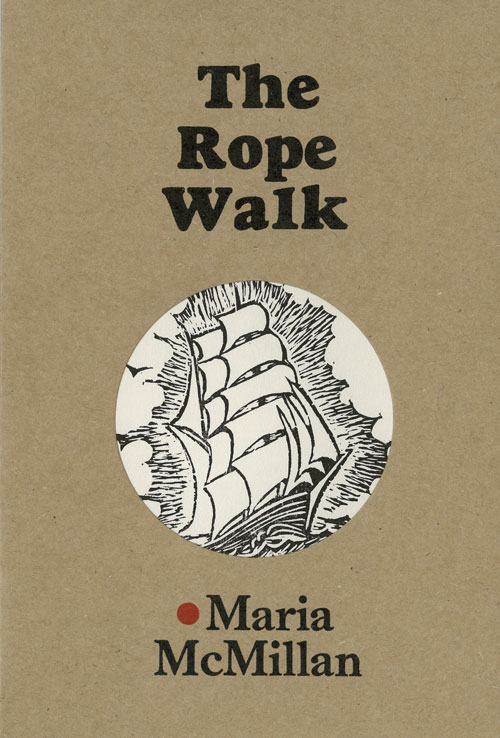
As well as having gorgeous poems, the book is also going to have a gorgeous cover:


It's been letterpress printed by Joe Buchanan, Maria's partner, and yes, that is a die cut (ie hole) in the centre, through which we can see a linocut of a sailing ship, also done by the very talented Joe.

We're launching it on Saturday 13th July, at 3 pm, at the Aro Community Centre, Aro Street. Hope you can come along. Here's the Facebook event: http://www.facebook.com/events/202894136531214/.

And now, if you're in search of other poems, head on over to the hub blog, where you'll find a poem about Palmerston North by Jennifer Compton, and links to other new Tuesday Poems:  http://tuesdaypoem.blogspot.co.nz/.

01 June 2013

So, I seem to have published a bestselling book...

It's been a pretty cool week. After the book launches of the week before, we went away last weekend, and spent the weekend reading, writing, rebalancing, wandering around, watching DVDs and spending as much time as possible sitting in front of the open fire.

And then this week, on Thursday, I found out the The Baker's Thumbprint (the book I've just published) was number 7 on the NZ fiction bestseller list! Look here if you need proof (I certainly did!): http://www.seraphpress.co.nz/1/post/2013/05/the-bakers-thumbprint-debuts-at-no7-on-nz-fiction-bestseller-list.html.

I'm really blown away and excited. And kind of shocked. I know it's due to having the books turn up at bookshops the same week we had two launches (one in Auckland and one in Wellington), and it's also the first time I've sold all the launch books through bookshops, rather than directly, but it's also due to Paula Green, who has a very strong personal following. But I think it also is signalling that Seraph Press is getting to a new level of respect, which makes me very happy.

I doubt that the book will keep up quite that high level of sales, but Paula is going to be interviewed on Arts on Sunday on the radio tomorrow (http://www.seraphpress.co.nz/1/post/2013/05/paula-green-on-arts-on-sunday.html), so hopefully that will spark more interest.

And now I need to get the next book (The Rope Walk, by Maria McMillan) finished!

27 May 2013

Tuesday Poem: 'The Nail' by Therese Lloyd

The Nail

Where I am—generic architecture
like a barn or a bach but
neither of those things
Feral fennel clots the air with ammonia
and the usual marks are everywhere—
burnt stumps and discarded branches
their currency clattering at the night-window

I've made a list of things I will steal:
a Crown Lynn cup and saucer
an ashtray printed with Foxton: the Foxy Town
and a remote control like the one I lost—
but I won't, I will leave this place
cleaner than when I arrived

If I could get things right on a small scale
if I could lay the right things
at the feet of the wooden women
who circle the ladder to heaven
Or reign Foveaux's rusty breath
to skirt these hingeless doors
But my vision is split like a horse's
and my pockets hurt from the fists
I've shoved in them

Round back the muttonbirders are dumping the buckets
of bodies in the kitchen sink
the ovens and deep fryers gearing up a notch
We prepare ourselves by mumbling a song
taught to us this morning
half naïve native, half colonial hucksters
sung to a Beatles tune
Standing on the grass, I let a nail
pushed from rusted metal
pierce the sole of my shoe

Therese Lloyd


This poem comes from Therese Lloyd's poetry collection Other Animals, which was published earlier this year, and which I've recently finished reading.There's a fresh voice in the poems. I particularly wanted to share this poem because there are several bits in it that when I read them I had that twinge you sometimes have when you kinda wish you'd written them.

In case you're nosey to know, they are: 'I've made a list of the things I will steal:/A Crown Lynn cup and saucer/an ashtray printed with Foxton: the Foxy Town'; 'if I could lay the right things/at the feet of the wooden women/who circle the ladder to heaven' and 'my pockets hurt from the fists/I've shoved in them'.

The last of these matches nicely with the the last few lines - the actor and the acted upon are switched - the narrator 'lets' the nail pierce her shoe (and, perhaps, more gruesomely her foot); the pockets are sore, not the fists.

I'm not quite sure what's going on in this poem, but clues suggest a stay on Stewart Island/Rakiura, or possibly one of the Tītī (muttonbird) Islands. It's certainly during muttonbird season. Where ever it is, it seems like the end of the earth.

As well as Other Animals, Therese has also had a very limited edition collection of her work, Many Things Happened, published by Pania Press. She spent a year attending the Iowa Writers' Workshop after being awarded the Schaeffer scholarship, and now is back living in Paekakariki.

And there are more Tuesday Poems, for your reading pleasure, over at the hub: http://tuesdaypoem.blogspot.co.nz/.


13 May 2013

Tuesday Poem: 'Thursday' by Paula Green

Thursday
(for Jenny Bornholdt)

If you look beneath the floorboards
of this poem you might find
endless days of rain and wind
on the Waitākere Ranges.

Between the walls you might see
a garden that needs spring plants.

You might stumble upon
the story of a mathematician
who knits patches for a quilt because she
can never recall what she saw
the month before

or the story of a philosopher
who walks in circles
to seek the meaning of life
or lost things or why the heart
and not the lungs
registers the pulse of love.

My house waits
with its creaking walls
and everything
is the same and then
different.

The wind crackles.
The bouillabaisse needs stirring.
Perhaps it needs more salt.


Paula Green


I can't believe it's launch week already. On Saturday we've got the Auckland launch of The Baker's Thumbprint, and then next week it's the Wellington launch.

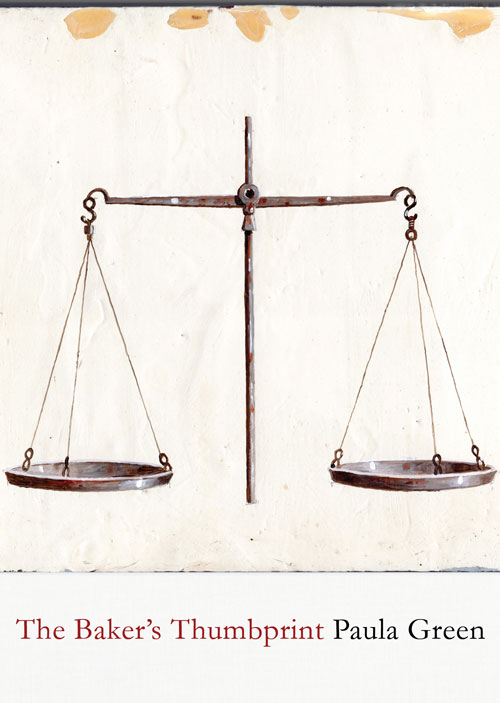
'Thursday' is the first poem in the book, and as soon as I read this in the manuscript I was pretty sure this was a book I wanted to publish. It's just gorgeous. My favourite lines are 'why the heart / and not the lungs /
registers the pulse of love', but there are so many more to love. It's a quiet, contemplative beginning to playful and frequently energetic book, but it has several of the themes that continue through the whole - secrets waiting to be discovered, philosophy, place, home and lunch - there's always lots of good food in a Paula Green book!

As ever, more Tuesday Poems await over at the hub blog: http://tuesdaypoem.blogspot.co.nz/.


11 May 2013

Launching The Baker's Thumbprint, Auckland and Wellington

If I haven't invited you already, then consider yourself invited!

We're launching Paula Green's new collection The Baker's Thumbprint (which I am/Seraph Press is publishing) in both Auckland and Wellington on the 18th and 21st of May. Come along to one or other, or both! The launch invitations are below, and the Facebook events are here for Auckland: http://www.facebook.com/events/468081233260334/ or here for Wellington: http://www.facebook.com/events/163956803780493/.