21 March 2011
Tuesday Poem: 'The Truth the Dead Know', by Anne Sexton
If you can't view the YouTube clip above, then click here: http://www.youtube.com/watch?v=PkCHYVgXHiQ
Reading Siobhan Harvey's Lost Relatives recently sent me back to Anne Sexton, as Siobhan has a couple of Anne-Sexton related poems at the end of the collection. So today, an audio poem of Sexton reading her own poem. Also, because there's been so much death around lately - both big disasters, and little disasters, which are no less big for the people who have lost someone they love.
Check out the other Tuesday poems on the Tuesday Poem blog: http://tuesdaypoem.blogspot.com/

19 March 2011
Robert Sullivan and Poetry Society (and Helen Cubed at the Ballroom)
I mentioned earlier that Robert Sullivan was reading at the Poetry Society in March, but it was in the middle of a long ranty post, so it's worth reiterating.
He's reading on Monday at 7 pm (which is earlier than usual), at the Thistle Inn, Mulgrave Street, Thorndon. There will be an open mic, and there is a $5 entry fee ($3 for members).
Also, Helen, Helen and I have been making preparations for our reading tomorrow at the Ballroom: http://wingedink.blogspot.com/2011/03/helen-cubed-come-see-us-read-poetry.html. I am still having serious debates with myself over what poems to read, but will try to read a mixture of older and newer stuff. See you there?
He's reading on Monday at 7 pm (which is earlier than usual), at the Thistle Inn, Mulgrave Street, Thorndon. There will be an open mic, and there is a $5 entry fee ($3 for members).
Also, Helen, Helen and I have been making preparations for our reading tomorrow at the Ballroom: http://wingedink.blogspot.com/2011/03/helen-cubed-come-see-us-read-poetry.html. I am still having serious debates with myself over what poems to read, but will try to read a mixture of older and newer stuff. See you there?
14 March 2011
Tuesday poem: 'Tooth' by Siobhan Harvey
 Tooth
ToothToday, you’re twelve teeth old,
and we fossick for shells,
star-fish, pipi and paua
until the tide goes out
when we wave goodbye
to yachts moored in the marina.
At home, you float
across polished floors
until you keel over.
Your jaw leaves an alveolus
in the matai deep enough
for a tear-drop’s caress.
As I stroke you,
your eyes collect water;
your gums are an ocean of blood.
But only when you’re sleeping,
do I discover a tooth
anchored to blue woollen blanket.
Suddenly, you’re eleven teeth old
and have grown, like Lazarus,
younger beneath moonlight.
White and hull-shaped,
tooth’s a boat,
isolated by low tide.
In the morning,
I’ll show you how it can rest
safely upon its starboard.
 Siobhan Harvey has just launched her first New Zealand collection of poetry, Lost Relatives, from which 'Tooth' comes. She's lived in New Zealand for a decade, but grew up in UK. She's the poetry editor for Takahe, and is a consulting editor of International Literary Quarterly. She was the editor of Words Chosen Carefully: New Zealand Writers in Discussion and Our Own Kind: 100 New Zealand Poems about Animals. I got to know Siobhan after accepting three of her poems for JAAM 22, and met her for the first time when she came down to Wellington as part of the Winter Readings. Since then, I've met up with her each time I go to Auckland, and it has been lovely getting to know her.
 Lost Relatives is, in great part, about Siobhan's experience of moving to New Zealand - leaving behind and, in a sense, losing her home and her family. And then building a new life here, with her new family, her partner, her son, and her 'found' family. Sometimes reading Lost Relatives was like finding old friends - there were many poems I'd read before, including those three poems I'd published in JAAM 22 all those years ago.
Last Thursday I went along to the offices of Steele Roberts for the Wellington launch of Lost Relatives. (She also launched it in Auckland, where she lives.) I wasn't surprised to find a bunch of other writers there, because Siobhan has a knack of making connections with people - not in a 'networking' sort of way, but in a genuine connection sort of way - and has made friends (found family) all over the country. Roger Steele began, Harry Ricketts launched the book, and then Siobhan spoke and did an excellent reading of some of the poems in the book.
I've chosen 'Tooth' as my Tuesday poem because it was one of the poems she read, and I was particularly struck by it - by its simplicity - a story of her son falling and losing a tooth - which belies its intricateness. I love especially the marine metaphors - 'keel over', 'your gums are an ocean of blood', discovering the tooth 'anchored' to the blanket, the tooth 'isolated by low tide'. I also really liked the idea of her son being 'twelve teeth old', and then going back in time to being only eleven teeth old. He was at the launch, and is now six (I think), so many more than eleven teeth old - but still has the gap where the tooth once was.
As always, check out the other Tuesday poems via the Tuesday Poems blog: http://tuesdaypoem.blogspot.com/.
12 March 2011
Helen Cubed – come and see (and hear) us read poetry
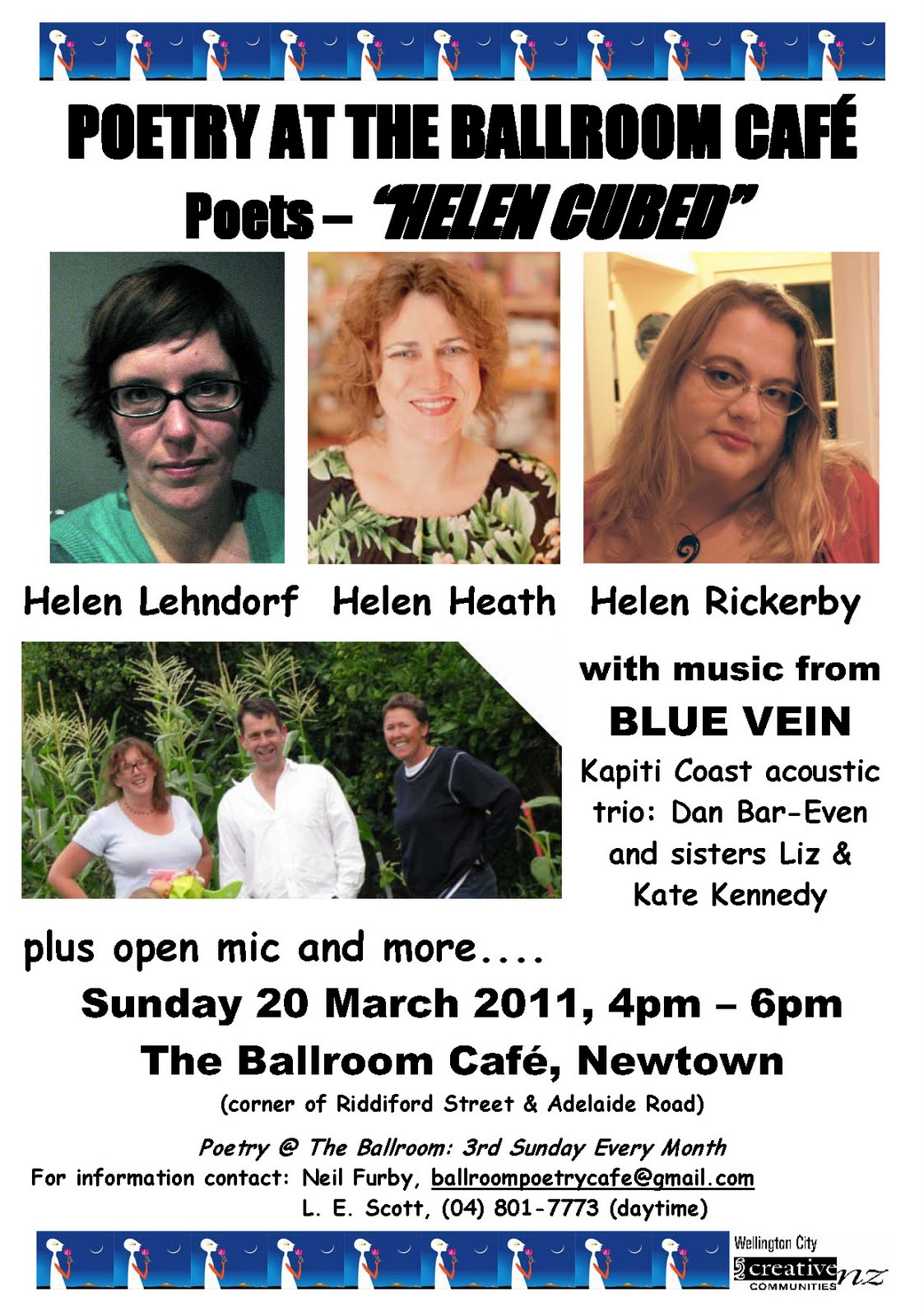
On a lighter note (not that we will necessarily be reading light poetry), I will be reading at the Ballroom Cafe next Sunday with Helen Heath and Helen Lehndorf. Together, we are Helen Cubed.
It'll all start with an open reading, followed by live music by Blue Vein (Dan Bar-Even, Liz & Kate Kennedy), followed by Helen Cubed. It will be awesome, because what could possibly be better than three Helens? (Four Helens I guess...)
Look, there's even a Facebook event, you don't even need to remember when it is, because it Facebook will remind you: http://www.facebook.com/?sk=events#!/event.php?eid=154114791313415
What is with you, 2011?!
2011 is supposed to be the year of poetry, for me at least. And has been. But it was not supposed to be the year of a whole bunch of horrible stuff. I'm grateful that it hasn't been for me personally, but I'm really feeling for everyone for whom this is year has been crap, what with earthquakes and tsunamis and floods, and, for other people, smaller but personally huge tragedies. I'm trying not to feel helpless in the face of it all. And, meanwhile, I'm appreciating my life and the people in it.
09 March 2011
Tuesday(ish) poem: 'Poetry with Beatrice and Laura'
 Poetry with Beatrice and Laura
Could Beatrice have written like Dante
Or Laura glorified love’s pain?
I set the style for women’s speech
God help me shut them up again.
― Anna Akhmatova
First we discuss Beatrice’s poem
It’s about her stalker
how he hides
around corners, appears
everywhere
she goes, pretends
to be walking the other
way, pretends
he doesn’t see her
‘I don’t think he’s dangerous’
she says, ‘but he really gives me the willies’
We praise
her sharp images
the melody of rhythm, conciseness of form
her humour
I suggest she might want to change
the names
‘He just needs a proper girlfriend,’ says Laura
and she knows
what she’s talking about
she too
has a bad case of the secret admirer
‘It’s just been embarrassing,’ she says
‘I have to publish
under a pseudonym
“Oh, you’re that Laura,” they used to say
“Laura ‘whose beauty was the envy of the sun’”?
No editor would take me seriously anymore’
Her poem, a perfect sonnet
is about love and pain
and how they are not
the same thing
‘Something my grandson
should have learnt,’ she giggles
It is a departure for her
She usually writes political satire
As the theme
has turned around to love
poetry I confess that since
I have been in love
love poems have been
scarce
I suggest that there is something
about the distance, the artifice
of infatuation
that lends itself
to voluminous words
Beatrice and Laura groan
Beatrice says, ‘My husband read
what he wrote about me: “Turn, Beatrice
o turn your holy eyes upon your faithful one,”
and he said “Dante should come and live with you
for a few days, then he’ll know
how human you are,” but then
he kissed me and said
“and that’s why I love you”
Same time next
week we’ll meet again
at Beatrice’s house
and over tea and cake
bring our latest clutch of poems out
into the light
OK, so not actually Tuesday anymore, but I've missed posting a Tuesday poem for several weeks now, for various reasons, and thought it was time I got back into the swing of it.
I mentioned this poem in my last post, and talked about how I was inspired to write it after getting annoyed by that quote by Anna Akhmatova. It was going to be one of the poems in the last section of My Iron Spine, where I hang out with women from history, but I took it out because I wasn't entirely sure about it. I'm kinda fond of it though.
Beatrice Portinari (1266–1290) was a Florentine lady, best known as the woman loved from a distance by Italian poet Dante Alighieri. She is worshipped in many of his poems and appears in The Divine Comedy as a guide to paradise. It is likely that Dante only actually met Beatrice twice in his life. Laura de Noves (1310–1348) was a lady of Avignon, believed to be the woman loved from afar by the poet Petrarch and the subject of many of his sonnets. She was probably an ancestor of Marquis de Sade.
You will find many other Tuesday poems via the Tuesday Poem blog.
02 March 2011
February poetry reading (6-10)
My reading has been rather haphazard, but I seem to have managed to read some poetry books. I got a whole bunch out of the library, and now they are all overdue, sigh, and I'd better take them back. This is why I'm generally not a library user - due dates mean nothing to me, and then it ends up being cheaper buying books...
Vita Nova by Louise Glück (6/52)
I have conflicted feelings about this book. Louise Glück is a celebrated contemporary US poet, she's won lots of prizes, including for this book, but most of it didn't seem very good to me. That isn't to say that it isn't good, but more that it sent me in a bit of a spin because I couldn't see why it was good. Is it a problem with me? I guess this happens a lot - people raving about something that doesn't speak to me at all, which seems clumsy or lacking a point - and I guess we all just have different taste. But still...
There was some lovely stuff in Vita Nova though, even for me. The collection is telling a subtle story of the narrator's rebirth into life after something happened. There are snatches of a failed love affair and it's all mixed in with mythology. Should have been right up my alley. And some of it was. Here's my favourite quote:
I probably didn't come into it with the most receptive attitude - when working on My Iron Spine I wrote a poem called 'Poetry with Beatrice and Laura', where I have a poetry-writing group with Beatrice and Laura (the beloved of Petrarch). I wrote it after I was really annoyed by this epigram by Anna Akhmatova:
Anyway...
Music Therapy by Peter Olds (7/52)
In contrast, I really enjoyed this book. It's quite simple, accessible and balanced. I reminded me of nothing as much as James K Baxter's Jerusalem poems, and I imagine it may be written in that tradition - Olds spent some time at Jerusalem in the 1970s. Similarly, many of these poems are about a time spent living differently, in solitude. In the 1980s Olds lived for a while in a hut at Seacliff, near the old psychiatric hospital. Like Baxter's poems, he will often describe things he sees around him, which will very subtly be metaphorical of what's going on for him. The rest of the book focuses on Dunedin in the 1990s, after a breakdown. I would include a quote, but that book has gone back to the library, to avoid further fines.
Soft Sift, by Mark Ford (8/52)
I picked this one up from the library cos it's published by Faber and sounded interesting. I'd never heard of Mark Ford before this, but then I have an appalling lack of knowledge of contemporary poets who don't live in NZ, which is what I'm trying to rectify this year.
I started reading this one afternoon, while I was in a grumpy-pants mood, and had wandered down to sit in the park in the sun to have some alone time. When I read some more, I was sitting on a concrete thing at Oriental Bay, with my feet being lapped by occasional waves - until I retreated because the tide was coming in and a particularly huge wave soaked my skirt, my bag, and dampened the book (don't tell the library). I finished it off sitting at my dining room table. This is basically irrelevant, except that now it's intimately connected with those locations in my head.
I found the poetry itself really dense. I described it to friends as kind of like eating dessert while drinking something also very sweet. I can totally enjoy dense, rich, even sticky poetry, and I did enjoy quite a bit of this, but I found I had to keep rereading lines - there seemed to be a lot of words without a clear meaning - not in a metaphorical sense so much, but as in a sense sense (if that makes any sense). For example, the first two lines of 'Penumbra': Beneath an angular web of scratchings-out/Vagrant motives glow like phosphorus: low, creeping' (though actually, that seems to make more sense now than it did before...).
I confess, I read a lot of the poems without really getting them - and now have forgotten them entirely. But one that has really stuck with me is 'The Long Man', about the Long Man of Wilmington, well, at least partly - you know poems, tricksy things – they're generally about stuff other than what they're about. Anyway, it begins 'The Long Man/of Wilmington winces with the dawn; he has just/endured yet another mythical, pointless, starry/vigil'. A favourite bit: 'I had/ the 'look', as some called it, meaning I floated/in an envelope of air that ducked and sheered/between invisible obstacles.' And the end:
... I kept picturing someone tracing
a figure on the turf, and wearing this outline
into a path by walking and walking around
the hollow head, immobile limbs, and cavernous torso.
Piki Ake! and Voice Carried My Family by Robert Sullivan (9–10/52)
I read these in preparation for Robert Sullivan's reading at the Poetry Society in March. Piki Ake!, his second collection, is from 1993, while Voice Carried My Family is from 2005. There's a bit of a gap in between (though, there are other books in this gap), and there does seem to me to be a development of style, as well as some similarities and similar interests and concerns. Both draw on Maori culture, stories and heritage, and both show the influence of waiata. Pike Ake! seemed more ... informal - I'm not even sure that's the right word. Perhaps looser is more what I mean. It has quite a few personal stories, including several poems telling the story of a family reunion up in Northland. There's still personal stories in Voice Carried My Family, though they seem tighter, perhaps more sophisticated.
He tells others' stories too - such as the stories of Te Weherua and Koa, young Maori boys who hopped on board the Resolution in 1777. Sullivan also knows that telling others' stories is problematic: 'But I can't. I just can't take the middle of your throat./Who would I pay for the privilege?' ('3 Mai') I felt a similar issue when working on the 'biographical' poems in My Iron Spine - I wanted these women to be remembered and celebrated, I wanted to give them voice, but I knew that it was my voice I was giving them, not their own. I couldn't really know what their voices would say. It is a slightly uncomfortable appropriation.
I think my favourite poem from either collection is the mysterious and haunting '13 ways of looking at a blackbirder'. I can't possibly tell you exactly what it's about, but I kind of feel it. You know, like a David Lynch movie.
Anyway, I'm looking forward to seeing/hearing Sullivan read - I've never heard him before, and hearing how a poet read, their rhythms, can give you a whole new way of understanding their poetry.
Vita Nova by Louise Glück (6/52)
I have conflicted feelings about this book. Louise Glück is a celebrated contemporary US poet, she's won lots of prizes, including for this book, but most of it didn't seem very good to me. That isn't to say that it isn't good, but more that it sent me in a bit of a spin because I couldn't see why it was good. Is it a problem with me? I guess this happens a lot - people raving about something that doesn't speak to me at all, which seems clumsy or lacking a point - and I guess we all just have different taste. But still...
There was some lovely stuff in Vita Nova though, even for me. The collection is telling a subtle story of the narrator's rebirth into life after something happened. There are snatches of a failed love affair and it's all mixed in with mythology. Should have been right up my alley. And some of it was. Here's my favourite quote:
I lived in a tree. The dream specifiedVita Nova is, apparently 'written in the elected shadow of Dante', and so I thought now might be a good time to pick up that copy of Vita Nova/The New Life by Dante, which has been sitting on my shelf for some time. I'm still clawing my way through it, and perhaps it is just the translation, but it reads to me like the stalky obsessions of a very socially maladjusted young man, who could do with a bit of a slapping (except of course I abhor violence). It tells the story of how he saw Beatrice, fell in love with her, and then obsessed over her for years and years. He writes some poems. In between the poems he tells us what the poems mean and how they work (and how clever he is), and how he pretended he loved someone else, for some reason, and how he got so thin because of his love, and goodness me you really should have found some medieval Florentine psychotherapist, Dante, then perhaps you could have just asked her out and got it all over and done with.
pine, as though it thought I needed
prompting to keep mourning. I hate
when your own dreams treat you as stupid.
(Condo)
I probably didn't come into it with the most receptive attitude - when working on My Iron Spine I wrote a poem called 'Poetry with Beatrice and Laura', where I have a poetry-writing group with Beatrice and Laura (the beloved of Petrarch). I wrote it after I was really annoyed by this epigram by Anna Akhmatova:
Could Beatrice have written like DanteI normally like Anna Akhmatova's poetry, but this infuriated me, and I wanted to give some kind of voice to those women, who haven't gotten to have one in history.
Or Laura glorified love’s pain?
I set the style for women’s speech
God help me shut them up again!
Anyway...
Music Therapy by Peter Olds (7/52)
In contrast, I really enjoyed this book. It's quite simple, accessible and balanced. I reminded me of nothing as much as James K Baxter's Jerusalem poems, and I imagine it may be written in that tradition - Olds spent some time at Jerusalem in the 1970s. Similarly, many of these poems are about a time spent living differently, in solitude. In the 1980s Olds lived for a while in a hut at Seacliff, near the old psychiatric hospital. Like Baxter's poems, he will often describe things he sees around him, which will very subtly be metaphorical of what's going on for him. The rest of the book focuses on Dunedin in the 1990s, after a breakdown. I would include a quote, but that book has gone back to the library, to avoid further fines.
Soft Sift, by Mark Ford (8/52)
I picked this one up from the library cos it's published by Faber and sounded interesting. I'd never heard of Mark Ford before this, but then I have an appalling lack of knowledge of contemporary poets who don't live in NZ, which is what I'm trying to rectify this year.
I started reading this one afternoon, while I was in a grumpy-pants mood, and had wandered down to sit in the park in the sun to have some alone time. When I read some more, I was sitting on a concrete thing at Oriental Bay, with my feet being lapped by occasional waves - until I retreated because the tide was coming in and a particularly huge wave soaked my skirt, my bag, and dampened the book (don't tell the library). I finished it off sitting at my dining room table. This is basically irrelevant, except that now it's intimately connected with those locations in my head.
I found the poetry itself really dense. I described it to friends as kind of like eating dessert while drinking something also very sweet. I can totally enjoy dense, rich, even sticky poetry, and I did enjoy quite a bit of this, but I found I had to keep rereading lines - there seemed to be a lot of words without a clear meaning - not in a metaphorical sense so much, but as in a sense sense (if that makes any sense). For example, the first two lines of 'Penumbra': Beneath an angular web of scratchings-out/Vagrant motives glow like phosphorus: low, creeping' (though actually, that seems to make more sense now than it did before...).
I confess, I read a lot of the poems without really getting them - and now have forgotten them entirely. But one that has really stuck with me is 'The Long Man', about the Long Man of Wilmington, well, at least partly - you know poems, tricksy things – they're generally about stuff other than what they're about. Anyway, it begins 'The Long Man/of Wilmington winces with the dawn; he has just/endured yet another mythical, pointless, starry/vigil'. A favourite bit: 'I had/ the 'look', as some called it, meaning I floated/in an envelope of air that ducked and sheered/between invisible obstacles.' And the end:
... I kept picturing someone tracing
a figure on the turf, and wearing this outline
into a path by walking and walking around
the hollow head, immobile limbs, and cavernous torso.
Piki Ake! and Voice Carried My Family by Robert Sullivan (9–10/52)
I read these in preparation for Robert Sullivan's reading at the Poetry Society in March. Piki Ake!, his second collection, is from 1993, while Voice Carried My Family is from 2005. There's a bit of a gap in between (though, there are other books in this gap), and there does seem to me to be a development of style, as well as some similarities and similar interests and concerns. Both draw on Maori culture, stories and heritage, and both show the influence of waiata. Pike Ake! seemed more ... informal - I'm not even sure that's the right word. Perhaps looser is more what I mean. It has quite a few personal stories, including several poems telling the story of a family reunion up in Northland. There's still personal stories in Voice Carried My Family, though they seem tighter, perhaps more sophisticated.
He tells others' stories too - such as the stories of Te Weherua and Koa, young Maori boys who hopped on board the Resolution in 1777. Sullivan also knows that telling others' stories is problematic: 'But I can't. I just can't take the middle of your throat./Who would I pay for the privilege?' ('3 Mai') I felt a similar issue when working on the 'biographical' poems in My Iron Spine - I wanted these women to be remembered and celebrated, I wanted to give them voice, but I knew that it was my voice I was giving them, not their own. I couldn't really know what their voices would say. It is a slightly uncomfortable appropriation.
I think my favourite poem from either collection is the mysterious and haunting '13 ways of looking at a blackbirder'. I can't possibly tell you exactly what it's about, but I kind of feel it. You know, like a David Lynch movie.
Anyway, I'm looking forward to seeing/hearing Sullivan read - I've never heard him before, and hearing how a poet read, their rhythms, can give you a whole new way of understanding their poetry.
26 February 2011
The earthquake
It's unbelievable, and all the words I string together about it are kind of feeble in the shadow of it. It was a week spent flicking between things on the internet (I learned early on that I couldn't bear to watch television coverage), and then trying to not keep reading things on the internet, because it wasn't really helping anyone. Twitter really came into its own though - I got better information from there most of the time than from the media sites, and it helped people get in touch with each other and help each other.
Fortunately, all the people I have direct contact with in Christchurch have come through ok. Unfortunately this isn't true for everyone - when I heard on Wednesday that a colleague's father-in-law had died, it really brought it home. What can we say to people who have lost people, or their houses, or their jobs and livelihoods, except we're so, so sorry.
Actually, I've noticed a lot of people have been doing more than that. Straight away people were finding ways to raise money to help. On Thursday I gave some money to a girl on Cuba Mall, who was singing and collecting money, because she just wanted to do something. Some creative people have gotten really creative about this: some local writers are going to publish a fiction anthology, Tales for Canterbury and gamers have put together a bundle of RPGs, both with profits going to help in Christchurch. I think it shows how much most people, despite our own petty selfishnesses, do really care about each other. And, in relation to other events this week, I don't think we actually want New Zealand to be as unequal as it has become.
Fortunately, all the people I have direct contact with in Christchurch have come through ok. Unfortunately this isn't true for everyone - when I heard on Wednesday that a colleague's father-in-law had died, it really brought it home. What can we say to people who have lost people, or their houses, or their jobs and livelihoods, except we're so, so sorry.
Actually, I've noticed a lot of people have been doing more than that. Straight away people were finding ways to raise money to help. On Thursday I gave some money to a girl on Cuba Mall, who was singing and collecting money, because she just wanted to do something. Some creative people have gotten really creative about this: some local writers are going to publish a fiction anthology, Tales for Canterbury and gamers have put together a bundle of RPGs, both with profits going to help in Christchurch. I think it shows how much most people, despite our own petty selfishnesses, do really care about each other. And, in relation to other events this week, I don't think we actually want New Zealand to be as unequal as it has become.
09 February 2011
JAAM calls for submissions for issue 29
Finally! Woo! It's later than usual, because I've been busy sorting out things, but these things seem to work out the way they're supposed to...
I'm really delighted that Anne Kennedy is going to be our guest editor. For more info, check out the call for submissions: http://jaam.wordpress.com/2011/02/08/call-for-submissions-for-jaam-29/.
I'm really delighted that Anne Kennedy is going to be our guest editor. For more info, check out the call for submissions: http://jaam.wordpress.com/2011/02/08/call-for-submissions-for-jaam-29/.
07 February 2011
Tuesday Poem: 'severe weather warning' by Vivienne Plumb (and interview)
 Vivienne Plumb was interviewed on the Radio New Zealand National Arts on Sunday show, by Lynn Freeman. It begins with Vivienne reading 'severe weather warnings', from Crumple, so that's my Tuesday Poem today. You can listen to it here: http://podcast.radionz.co.nz/art/art-20110206-1448-Vivienne_Plumb-048.mp3.
Vivienne Plumb, with a New Zealand mother and Australian father, has spent much of her life crossing the Tasman. She is one of literature’s all-rounders; as well as six previous collections of poetry, she has written and published plays, short fiction and a novel.
Vivienne has held many awards and residencies, including the Hubert Church Award for a first book of fiction, which she won for her collection The Wife Who Spoke Japanese in Her Sleep (1993), the Buddle Findlay Sargeson Fellowship and the University of Iowa International Writing Programme.
Not one to sit still, she is currently dividing her time between Auckland and Sydney, where she is completing a doctorate in creative arts.
05 February 2011
Vivienne Plumb interviewed on Radio New Zealand
 As I've just blogged over on my shiny new Seraph Press site (which suddenly seems to have grown 'like' and 'tweet' buttons that I'm not entirely certain I like) Vivienne Plumb is going to be interviewed by Lynn Freeman on the Arts on Sunday show this Sunday (at 2.30 pm). More details on the Seraph Press site: http://www.seraphpress.co.nz/1/post/2011/02/vivienne-plumb-talks-about-crumple-on-national-radio.html (go on, humour me and have a look - I've just managed to get Google Analytics to work on the site, finally, so every visit will make me happy.)
I'm really excited about this interview, and the fact that I have been involved in organising three upcoming Seraph Press-related readings - I'm feeling like maybe I'm not such a totally useless publicist after all.
More details about the readings will follow, but the first one up, which is the most finalised, is Helen Cubed (me, Helen Heath and Helen Lehndorf) at the March Ballroom Poetry Cafe in Wellington.
31 January 2011
Tuesday Poem: from The Time of Giants, by Anne Kennedy
 from Cinema, the sad ending 'o'
3.
Have you seen Psycho? No. Vertigo? No.
Rear Window?
No.Rope? Nope. They don't
make them like that any more. No.
In that case have you read
The Inferno? No.
In that case did you see
The Towering Inferno? No.
Have you seen you know? No.
Have you? No.
Okay have you read Plato? No.
Bassho? No.
Sappho? No.
Purgatorio? No.
Paradiso? No.
Umberto Eco? No.
Daniel Defoe? No.
Othello? No.
Orlando? No.
Waiting for Godot? No.
Living in the Maniototo? No.
Crow? No.
Wodwo? No
Alice Munro? No.
Gregory Corso? No.
Edgar Allan Poe? No.
Allen Curnow? No. Wystan Curnow? No. Any Curnow? No.
Black Rainbow? No.
The Rainbow? No.
Whanau? Nau.
The Pisan Canto? No.
Rimbaud? Naud.
Don DeLillo? No.
Alan Sillitoe? Noe.
Joy Harjo? No.
Leslie Marmon Silko? No.
Steven Winduo? No.
Timothy Mo? No.
Henry D. Thoreau? Neau. Paul Theroux? Noux. Any Th...? No.
Robinson Crusoe? Noe.
Ivanhoe? Noe.
Te Kaihau? Nau.
The Kumu Lipo. No.
Under the Volcano? No.
The Aloe? Noe.
The Loss of Eldorado? No.
Miss Smilla's Feeling for Snow? No.
Barbara Trapido? No.
Henry and Cato? No.
The Wide Window? No.
The Grim Grotto? No.
Oh, the Places You'll Go!? No.
Kate DiCamillo? No.
Go Dog Go? No.
Do you remember Yoko Ono? No.
Juno
and the Paycock? No.
Anthony and Cleo-
patra? No.
The Canto
General? No.
Beo-
wulf? No.
O-
vid? No.
O-
sip Mandelstam? No.
Flann O'
Brien? No. Greg O'Brien? No. Any O'B…? No.
Baby No
Eyes? No.
The Go-
Between? No.
The po-
em with the women coming and go-
ing? No.
You do know
the coming and go-
ing one? No.
Oh
so
no coming and going then? No.
War And Peace?
Yes.
Really?
No.
I mentioned the other day that I'd recently reread The Time of the Giants by Anne Kennedy. The context of this poem is that Moss, the protagonist, is out on her first date with Paul, her new boyfriend. She is taking pains (literally) to avoid him from finding out that she is a giant. They are about to go into the movie (Shakespeare in Love). From their discussion, you might guess that they are rather different sorts of people. Moss is rather more cultured.
What I love particularly about this poem, or rather section of a poem, is its playfulness, its rhythm and rhyme and cleverness, and all the different ways of saying no. I haven't tried reading it out loud - I'm sure it would be awesome - but it's the kind of poem that reads itself out loud in your head.
Anne Kennedy is a novelist, award-winning poet and short-story writer, editor, literary critic and scriptwriter. She's recently returned to Auckland from Hawai'i, where she was teaching creative writing.
Head on over to the Tuesday Poem blog for more Tuesday Poems: http://tuesdaypoem.blogspot.com/
30 January 2011
January poetry reading (2–5)
The Time of Giants by Anne Kennedy (2/52)
I was fortunate enough to meet Anne Kennedy at the launch for Crumple in Auckland in November. We've been corresponding and she very kindly sent me a copy of The Time of Giants. This is a re-read for me. I read and enjoyed it back in 2005 when it came out. I've enjoyed it even more this time through though - as I often do when I reread things I liked the first time. You often get more of the nuance and layers and so forth.
One thing I hadn't picked up on the first time, possibly because I hadn't read it yet, was its parallels with Autobiography of Red, by Anne Carson. Both are collections of linked narrative poems, aka verse novels, which modernise a character from myth. In Carson's case, a monster from Greek myth, and in Kennedy's case, a giant from Irish myth (though Moss, the protagonist, is not herself from a myth, she is a descendant of Irish giants, such as Finn MaCoul, whose story is told in the second section).
Moss and her brother Forest are giants, though their parents are normal height. This is really the story of Moss and her efforts to keep her normal-sized boyfriend Paul from realising she is so tall. I took this also as metaphorical for that feeling that I'm sure most people have - that they are some kind of freak, and are going to be found out at some point.
It's a really playful collection, with a playful story and playful and surprising use of language. I'm going to publish a piece as my Tuesday Poem soon, so you can see what I mean, if you haven't already read it.
Friend's poetry manuscript 3/52
I won't say much about this, with it being unpublished and all and still in progress (though basically ready to be unleashed on the world in my opinion). But I will say that it's great, and I'm excited about it. I'm going to be giving feedback and praise, so will read it a few more times, but I won't cheat by recording each read-through though.
100 Traditional Smiles, by Anne Kennedy 4/52
Because I'd just read The Time of Giants, and because I had recently acquired this book as part of a big bag of poetry books that a friend donated to me, I thought it was a good time to read it.
I'm not sure I should be counting this one, as it claims to be a novella, and is clearly written in prose, but it's very poetic prose, with only the loosest narrative (much looser than The Time of Giants), so I am claiming it as prose-poetry verse novel(la).
Like The Time of Giants, it's wonderfully inventive and surprising. In the more than 100 sections (I would count them, but I put the book down somewhere and now can't find it) of varying lengths, from short to really short, it jumps between a series of characters, including 'the woman' (actually I think several of them are referred to as 'the woman' and I wasn't always sure which one was meant, which I'm sure was deliberate), the Italian couple, Eileen, Irene, Leslie, the Hoboken couple (former New Zealanders living in New Jersey), the graphic designer and even, in a few places, an 'I'. They are in various parts of the world - New Jersey, as I mentioned, Auckland, Gore, New York, Nottingham. Some know each other, some don't, but there are threads, or rather wools, connecting many of them.
Northland, by Michele Leggott (5/52)
Northland is a gorgeous hand-made book from Pania Press (Jack Ross and Bronwyn Lloyd). I was keen to get my paws on a copy because it's about, or perhaps rather set in, the same areas as my book Heading North. Northland is a gorgeously produced book, and it was lovely revisiting some of these places in poetry. I think my favourite of the poems was 'listening', with the repeated line at the end of the three stanzas 'unwinding the bird in my throat'.
I was fortunate enough to meet Anne Kennedy at the launch for Crumple in Auckland in November. We've been corresponding and she very kindly sent me a copy of The Time of Giants. This is a re-read for me. I read and enjoyed it back in 2005 when it came out. I've enjoyed it even more this time through though - as I often do when I reread things I liked the first time. You often get more of the nuance and layers and so forth.
One thing I hadn't picked up on the first time, possibly because I hadn't read it yet, was its parallels with Autobiography of Red, by Anne Carson. Both are collections of linked narrative poems, aka verse novels, which modernise a character from myth. In Carson's case, a monster from Greek myth, and in Kennedy's case, a giant from Irish myth (though Moss, the protagonist, is not herself from a myth, she is a descendant of Irish giants, such as Finn MaCoul, whose story is told in the second section).
Moss and her brother Forest are giants, though their parents are normal height. This is really the story of Moss and her efforts to keep her normal-sized boyfriend Paul from realising she is so tall. I took this also as metaphorical for that feeling that I'm sure most people have - that they are some kind of freak, and are going to be found out at some point.
It's a really playful collection, with a playful story and playful and surprising use of language. I'm going to publish a piece as my Tuesday Poem soon, so you can see what I mean, if you haven't already read it.
Friend's poetry manuscript 3/52
I won't say much about this, with it being unpublished and all and still in progress (though basically ready to be unleashed on the world in my opinion). But I will say that it's great, and I'm excited about it. I'm going to be giving feedback and praise, so will read it a few more times, but I won't cheat by recording each read-through though.
100 Traditional Smiles, by Anne Kennedy 4/52
Because I'd just read The Time of Giants, and because I had recently acquired this book as part of a big bag of poetry books that a friend donated to me, I thought it was a good time to read it.
I'm not sure I should be counting this one, as it claims to be a novella, and is clearly written in prose, but it's very poetic prose, with only the loosest narrative (much looser than The Time of Giants), so I am claiming it as prose-poetry verse novel(la).
Like The Time of Giants, it's wonderfully inventive and surprising. In the more than 100 sections (I would count them, but I put the book down somewhere and now can't find it) of varying lengths, from short to really short, it jumps between a series of characters, including 'the woman' (actually I think several of them are referred to as 'the woman' and I wasn't always sure which one was meant, which I'm sure was deliberate), the Italian couple, Eileen, Irene, Leslie, the Hoboken couple (former New Zealanders living in New Jersey), the graphic designer and even, in a few places, an 'I'. They are in various parts of the world - New Jersey, as I mentioned, Auckland, Gore, New York, Nottingham. Some know each other, some don't, but there are threads, or rather wools, connecting many of them.
Northland, by Michele Leggott (5/52)
Northland is a gorgeous hand-made book from Pania Press (Jack Ross and Bronwyn Lloyd). I was keen to get my paws on a copy because it's about, or perhaps rather set in, the same areas as my book Heading North. Northland is a gorgeously produced book, and it was lovely revisiting some of these places in poetry. I think my favourite of the poems was 'listening', with the repeated line at the end of the three stanzas 'unwinding the bird in my throat'.
29 January 2011
New lit magazine from Kilmog
In other exciting news today, Kilmog Press, a Dunedin publishing company known for it's gorgeous hand-made books (including my own Heading North) is going to publish a literary journal, called Starch. AND, it's going to be hardback. It's open for submissions. It will be very cool. More info here: http://kilmogpress.blogspot.com/2011/01/open-for-submissions-starch-new-zealand.html
Seraph Press gets new website
 Woo! Seraph Press (which is basically me) has finally grown up and got it's own URL: http://www.seraphpress.co.nz. And I've finally built it a new site, which is currently not entirely dis-similar to the old one. I will be able to add news more easily, as it has a built-in blog, and I'm sure there are many other fabulous things I could do.
The old one (which I'll start redirecting from or something) was built on a Paradise homepage, with an old version of Dreamweaver that I got from my old work. And, because I don't know CSS, it was built in a series of tables and really was a bit of a pain (though it loaded super-fast).
This one is built on Weebly. Is anyone else using that? How are you finding it? It looked quite flexible and is, you know, free, unless you get pro, which I might perhaps, though mainly so I can add my favicon back (and add video).
For my first proper post on seraphpress.co.nz I've linked to Helen Heath's interview with Helen Heath. I published Helen Heath's debut chapbook Watching for Smoke, in 2009 (goodness, was it so long ago!). As part of her continuing series of interviews, she's put herself in the interviewee's chair. Check it out on her blog: http://www.helenheath.com/2-jan-2011/quick-ten-helen-heath.
24 January 2011
Tuesday Poem: 'Daddy' by Sylvia Plath (as read by Sylvia Plath)
If you can't view this embedded video, you can watch it on YouTube here: http://www.youtube.com/watch?v=6hHjctqSBwM
A quick Tuesday Poem today. I stumbled across this yesterday, and goodness me it's so exciting to hear Plath read her own poem - to hear what her voice sounded like for one (I have listening to recordings of her a long time ago, but I don't remember her voice being so deep), and also to hear how she reads this - where she puts stresses, the rhythm she uses, where she pauses.
When I came across this, I also came across the only surviving recording of Virginia Woolf's voice, and I know there will be so many other wonderful treasures of poets reading their work and writers voices, but I'm afraid to get started looking for them, because where will it end!?
Well, you can go and have a look for poetry on Youtube, but you can also go look for more Tuesday Poems on the Tuesday Poem blog: http://tuesdaypoem.blogspot.com/
23 January 2011
Nox, by Anne Carson (no. 1)

To be honest, I'm not even sure if this book really qualifies as poetry. It isn't immediately recognisable as a poetry book - it's much thicker for a start, is in a box, and is concertina folded. And when you look at the pages, you don't find what you'd immediately recognise as poetry. There are fragments, photos, scribbles, things that appear to pieces of peeled paint, and lots and lots of definitions of Latin words.
But, when you read them, they feel like poetry, and it's by a poet, so I'm counting it.
I'm a big fan of Anne Carson. She's a Canadian poet and the author of what, if asked, I say is my favourite poem: 'The Glass Essay' (I've written about it a couple of times on this blog). She's better known, I think, as the author of Autobiography of Red - a kind of verse-novel retelling/revisioning of a Greek myth about the monster Geryon and his relationship with Herakles - which I also love, but not as much.
I asked for Nox for Christmas, and it duly arrived via the internet - I haven't seen it in Unity Welly, though I did paw it in Unity Auckland but didn't have enough room in my bag to bring it home. As I said, it's a big book. As a physical object, it's gorgeous. (Oh hey, here's a video showing it on Youtube.) It's a facsimile of a scrapbook Carson made as an epitaph for her brother after he died. It tells his story, sort of, in little fragments, snatches, glimpses, riddles almost. She only had little snatches of him, really, because he 'ran away' at some unspecified age (sometime in early adulthood) to avoid prison - I don't think we are told what for, but intimations are drug dealing or possibly something to do with the death of a girl he loved - though that might have been later. And after he skipped the country the only direct contact Carson had with him was about five phonecalls over twenty-two years. So, anyway, these story snippets are mostly on the right-hand pages.
The book begins with a reproduction of a typed, slightly water damaged, poem in Latin.
On many of the left-hand pages are definitions of Latin words, much as one might find in a Latin-to-English dictionary. The definitions (it took me a little bit to realise, I'm afraid, but I was a bit ill at the time, so forgive my slowness) are of the words in the poem, defining each word's various meanings, subtleties, layers, and gives the word in the context of a few phrases. While these definitions are not always easy to read, they are each like little poems. For example, the definition for aequora begins:
a smooth or level surface, expanse, surface; a level stretch of ground, plain; inmensumne noctis aequor confecimus? have we made it across the vast plain of the night?Later, she tells us about the poem that begins the collection. It is by Catullus (poem 101), and he wrote it as an elegy for his brother, who had recently died. Carson, who teaches Classics at university, says how it had moved her, and how she tried several times to translate it, but:
Nothing in English can capture the passionate, slow surface of a Roman elegy. No one (even in Latin) can approximate Catullan diction, which at its most sorrowful has an air of deep festivity, like one of those trees that turns all its leaves over, silver, in the wind. I never arrived at the translation I would have liked to do of poem 101.She does, further in to the book, include an English translation of the poem, but the real translation of the poem is the accumulation of these definitions, which show the weight and power that sits behind each word.
As well as highlighting one of the difficulties of translation, it also for me emphasised the power of poetry - in a good poem, each word has all those layers of meaning sitting behind it. It may mean one thing on the surface, but another thing below that, text and subtext, punning and play.
It's getting late, and I'm ranting a little now, but this is a rich book - not easy, perhaps, but rich in language and rich in ideas and meaning - and a book I suspect I will return to over and over.
22 January 2011
2011, Year of Poetry*
*I should note first off that 2011 is not the year of poetry in any kind of official sense, and is in fact, according to Wikipedia, the International Year of Forestry, International Year of Chemistry, International Year for People of African Descent, and World Veterinary Year.
There's nothing like being on holiday to make me stop and think.
As soon as I did, I realised something was wrong.
I realised that poetry, something I consider one of the most important things in my life, has been consistently pushed (by me, I confess) to the bottom of my priority list. I have been neglecting it. The writing and revising of my own poetry, and the reading of other people's poetry, and generally being a poet (so, sitting around, especially in cafes, looking kinda melancholy and deep, thinking profound thoughts) doesn't have strict deadlines, and so is generally trumped by things that do.
Some of the things that get prioritised above my own poetry are also poetry-related - publishing other people's poetry through Seraph Press and JAAM - but I realised that while those things are very important to me, for my self personally my own poetry is more important, and I should stop putting it at the bottom of my list.
OK, so easier said than done.
I'm not planning to give up Seraph Press or JAAM, I have a full-time day job, I have a partner I quite like to hang out with often, and friends I like to see from time to time. I also really like sleeping. So how am I going to make this the year of poetry?
Well, I do have some ideas. One is to spend less time on the net, especially Twitter and Facebook, not so much because of the time, but more because I find it makes me attention-deficient - anxiously checking and clicking, finding that I'm looking for some kind of 'hit'. It puts me in a space that is kind of opposite to the space I need to be in to write poetry.
Something that puts me in a good head space to write poetry is reading poetry. Usually I find it very mind calming; slowing, but often sparking - a word, phrase or image often sends me off in a parallel or perpendicular direction. Also, you know, I like poetry, and I think it's important to have an idea of what the local and international poetry community is up to.
So, I have arbitrarily decided I'll try to read at least one poetry book a week. And while I'm unlikely to write detailed reviews and analyses of them, I do want to record them in some way - so expect blog posts.
I'm also looking for recommendations, so let me know collections or poets you think I'll like, or think I should read. I'm particularly interested in broadening my familiarity with contemporary overseas poets - though they are sometimes hard to get hold of around here.
Another thing I'm going to do is make sure I spend a lot of time hanging around in cafes - I tend to write better there, where - despite the busyness - there are fewer distractions that at home.
That said, my major poetry plan for the year is to finish 'Cinema' - what I hope will be my next book. I've been working on the poems for it for a while, and think I have most of what I need for the book - though I still have a few in mind. After Christmas I spent a few hours going through what I had and pulling out all the poems I didn't like so much, or which I don't think fit. Now I want to work on the structure/order/flow/narrative of the collection as a whole, and polishing the individual poems. Probably then I'll find spaces where new poems should be, which will want to be written too.
Secondary to that, is my next epic poetry project, which I started on in the middle of last year, and which I expect to take a while.
It's going to be a busy year.
There's nothing like being on holiday to make me stop and think.
As soon as I did, I realised something was wrong.
I realised that poetry, something I consider one of the most important things in my life, has been consistently pushed (by me, I confess) to the bottom of my priority list. I have been neglecting it. The writing and revising of my own poetry, and the reading of other people's poetry, and generally being a poet (so, sitting around, especially in cafes, looking kinda melancholy and deep, thinking profound thoughts) doesn't have strict deadlines, and so is generally trumped by things that do.
Some of the things that get prioritised above my own poetry are also poetry-related - publishing other people's poetry through Seraph Press and JAAM - but I realised that while those things are very important to me, for my self personally my own poetry is more important, and I should stop putting it at the bottom of my list.
OK, so easier said than done.
I'm not planning to give up Seraph Press or JAAM, I have a full-time day job, I have a partner I quite like to hang out with often, and friends I like to see from time to time. I also really like sleeping. So how am I going to make this the year of poetry?
Well, I do have some ideas. One is to spend less time on the net, especially Twitter and Facebook, not so much because of the time, but more because I find it makes me attention-deficient - anxiously checking and clicking, finding that I'm looking for some kind of 'hit'. It puts me in a space that is kind of opposite to the space I need to be in to write poetry.
Something that puts me in a good head space to write poetry is reading poetry. Usually I find it very mind calming; slowing, but often sparking - a word, phrase or image often sends me off in a parallel or perpendicular direction. Also, you know, I like poetry, and I think it's important to have an idea of what the local and international poetry community is up to.
So, I have arbitrarily decided I'll try to read at least one poetry book a week. And while I'm unlikely to write detailed reviews and analyses of them, I do want to record them in some way - so expect blog posts.
I'm also looking for recommendations, so let me know collections or poets you think I'll like, or think I should read. I'm particularly interested in broadening my familiarity with contemporary overseas poets - though they are sometimes hard to get hold of around here.
Another thing I'm going to do is make sure I spend a lot of time hanging around in cafes - I tend to write better there, where - despite the busyness - there are fewer distractions that at home.
That said, my major poetry plan for the year is to finish 'Cinema' - what I hope will be my next book. I've been working on the poems for it for a while, and think I have most of what I need for the book - though I still have a few in mind. After Christmas I spent a few hours going through what I had and pulling out all the poems I didn't like so much, or which I don't think fit. Now I want to work on the structure/order/flow/narrative of the collection as a whole, and polishing the individual poems. Probably then I'll find spaces where new poems should be, which will want to be written too.
Secondary to that, is my next epic poetry project, which I started on in the middle of last year, and which I expect to take a while.
It's going to be a busy year.
18 January 2011
Late Tuesday Poem: 'Partying with Katherine Mansfield'
 Partying with Katherine Mansfield
‘Don’t be a bore,’ says Katie
as she pulls me up by my arm
to the dance floor
She was proud to be the first woman
in the whole of London to wear purple stockings
She shows them off as she shimmies
her skirt above her knees
I teach her the twist and she spirals off
towards D H who has found
an ironing board from somewhere and
they take turns at sliding down, shrieking with laughter
She’s smiling and kissing
everyone in the room, sipping punch
now joining me at the open window
breathing in the cool night air
‘Today is a new day, a new year, a new age
It’s a new world,’ she says
‘We mustn’t live as if it isn’t’
Better late than never, I guess. My first Tuesday Poem of the year is the last poem in My Iron Spine, but one I mean to have lashings of hopefulness and forward-lookingness. Katherine was indeed said to have been the first woman in London to wear purple stockings. When I read her stories at high school (and liked them) the impression we got of her - or I did at least - was of some sweet kind of tragic creature. But actually she was much more exciting than that, and much more full of life.
Many Tuesday poets are getting back into it today. You can find them via the Tuesday Poem blog.
15 January 2011
Submit to Enamel
Submissions for the third issue of Enamel magazine close today. Have you submitted? I haven't. But we still have time! We have around 12 hours! I'm not sure I will manage it, but you can. You can! More details here: http://enamelmag.blogspot.com/2010/09/enamel-3-submissions-opening-november.html
Subscribe to:
Posts (Atom)


